Blog
Guests Stretching Salon Appointments? 5 Smart Ways to Revive Your Book
By Savannah Nethken
October 9, 2026
Your six-week regular is now booking every eight weeks. Another guest is skipping their usual refresh and waiting for the next full color appointment. If you’re noticing guests stretching salon appointments, those growing gaps can feel frustrating—even when your guests still love your salon.
When guests come in less often, your business feels it in your revenue, your team’s schedules, and the gaps in your appointment book.
So where do you start? Find out what is making guests wait, give them a clear plan, and make the next appointment easier to book.
Here are five ways to put that into practice.
First, understand what a few extra weeks can mean
A guest booking a $150 service every six weeks represents about $1,300 in service revenue over a year. If that same guest moves to every eight weeks, that drops to about $975.
That is a difference of roughly $325 per guest. Across 100 guests following that same pattern, it adds up to $32,500.
This is a simple annual estimate, not a prediction of lost profit. It assumes the same price, a 52-week schedule, and no other guests filling those openings. The point is that a small change in visit frequency can make a meaningful difference.
It also helps to separate two things: whether guests return and how often they return. A guest can be loyal while visiting less often.
Zenoti’s 2026 salon benchmark summary reports fewer new-guest visits in 2025 across both full-service and specialty salons in its dataset. Existing-guest visits were flat or increased, depending on the category. That does not mean every salon is seeing longer gaps, but it is a reason to pay attention to the guests you already have.
1. Find out why guests are waiting
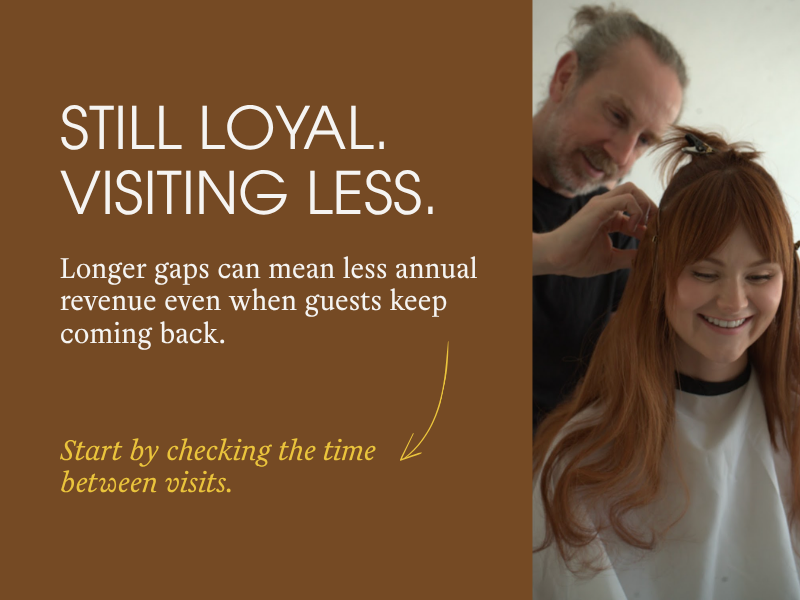
Before changing your menu or offering a promotion, look at what is happening.
Start with one service, like new growth coloring. Review a small group of regular guests and compare the time between their completed appointments with a similar period last year. Look for changes in price, stylist availability, or the services they are booking.
Then bring it into the consultation. If a guest who usually visits every six weeks returns after nine, try:
“You usually come in around six weeks, and this time it’s been nine. How did your color wear during those extra weeks?”
Listen first. If they mention cost or scheduling, ask a follow-up question about that specific concern. If they are happy with the longer grow-out, their maintenance needs may have changed.
A guest who cannot get an appointment after work needs a different response from someone who is trying to lower their spending.
Start this week: Look at 20 regular guests who book the same service. Note who is waiting longer and what you need to ask at their next visit.
2. Recommend the next appointment before checkout
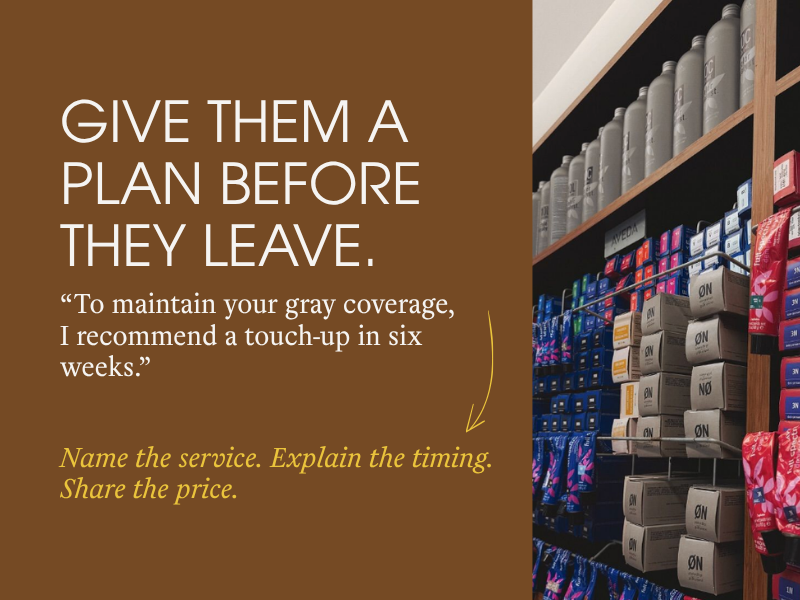
“Do you want to rebook?” gives the guest another decision to make without explaining why the next visit matters.
Instead, make a clear recommendation based on the result they want. Tell them what service they need next, when you recommend it, and what it will cost.
For a gray-coverage guest whose plan calls for six-week maintenance, that could sound like:
“To keep your gray coverage consistent, I recommend a touch-up in six weeks. That appointment is [price] and takes about [time]. Let’s look at the week of [date] before you leave.”
At the front desk, carry that recommendation through:
“Your stylist recommends your next touch-up the week of [date]. We have [specific day and time] available with them. Does that work for you?”
The timing should fit the guest’s hair, service, and goals. If they raise a concern, address it and adjust the plan together. Give them a clear starting point rather than a list of possibilities to sort through.
Start this week: Have each stylist practice one specific rebooking recommendation. Make sure the front desk knows the next service and timing before the guest checks out.
For support developing your team’s consultation and service skills, explore Neill’s education opportunities.
3. Offer an option between full appointments
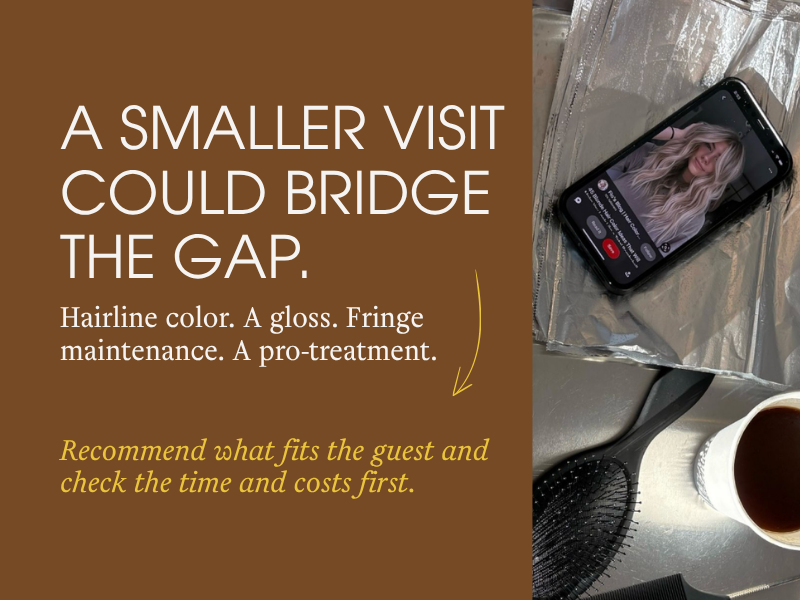
Some guests may benefit from a shorter appointment between larger services. Depending on your menu and the guest’s needs, that might be a hairline highlight, fringe maintenance, a gloss, or a professional treatment.
For guests who want to refresh shine or care for their hair between color appointments, a shine-focused service or Aveda Botanical Repair professional treatment can give them a reason to return without booking full color.
Be clear about what the service includes and what result it can deliver. A smaller service needs to be appropriate for that guest—it should not be presented as a substitute for work their hair actually needs.
For a guest who wants extra care between color appointments, a recommendation might sound like:
“If you’d like to give your hair some extra care before your next color visit, I recommend our Botanical Repair professional treatment. That appointment takes [time] and costs [price]. We can schedule it between your color appointments.”
For a suitable guest who has said a full appointment is difficult to fit in, a recommendation might sound like:
“For the gray you’re noticing around your hairline, I recommend our hairline touch-up between your full new growth appointments. It takes [time] and costs [price]. It covers that visible area; we’ll still keep your full touch-up appointment on the schedule.”
A treatment supports hair care between visits, while a targeted color service addresses a specific color need. Match the recommendation to the guest’s goals.
Before adding a service, work out the full appointment time and cost. Include products, staff pay, processing, finishing, and cleanup. A short application does not always mean a short appointment.
Also ask whether this will help someone return who would otherwise skip a visit, or mostly replace a full service they already book.
Start this week: Choose one maintenance service or professional treatment. Work out the price, time, and costs, then try it with a few guests it genuinely suits. Make sure your team knows what is included, how it fits between regular appointments, and who it is right for.
4. Make booking easier
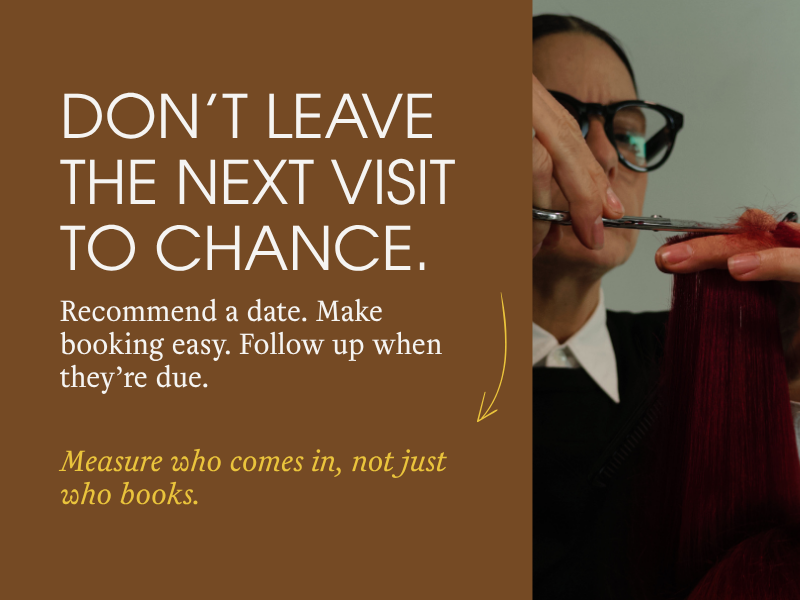
Sometimes the guest wants to come back, but booking takes more effort than it should.
In Zenoti’s booking survey, 71% of surveyed salon regulars said they had decided not to book because reaching someone or booking online was difficult. That is a survey finding, not a measure of your salon’s missed appointments, but it is worth checking your own process.
Try booking from your phone. Are service names easy to understand? Is pricing information available? Can a guest find a time or get help when their stylist is fully booked?
Reserve the next visit around the maintenance plan discussed in the chair. Send reminders with a clear way to confirm or reschedule, and use your waitlist to fill openings.
If a guest declines to book, find out what is holding them back. If they cannot confirm their work schedule yet, you can ask permission to follow up when they will know it.
And remember: a booked appointment only becomes service revenue when the guest comes in. Track cancellations and rescheduling alongside rebooking.
Start this week: Test your booking link and fix one confusing step. Review a few recent prebooked appointments to see how many guests actually came in.
5. Follow up with a specific reason to return
A useful follow-up should connect to the guest’s last service and the plan you discussed.
Start with regular guests who are past their recommended return date and do not have another appointment booked. Check their history first so you are not contacting someone who is already following a longer maintenance plan.
For a guest due for the touch-up you previously recommended:
“Hi [Name], it’s [Name] from [Salon]. You’re due for the touch-up we discussed at your last visit. [Stylist] has [day/time] available. Reply if you’d like us to reserve it for you.”
Only offer an opening you have checked, and use your salon’s approved messaging process and the guest’s contact preferences.
You do not need to lead with a discount. A personal message, a relevant recommendation, and an available appointment give the guest a clear next step.
Start this week: Have one team member review 10 guests who are due back. Send a personal follow-up where appropriate, then track replies, bookings, and completed visits separately.
Keep the first month simple
Choose one service category and one improvement your team can put into practice.
- Week 1: Review guest visits and identify what has changed.
- Week 2: Practice the stylist and front-desk recommendations. Fix one booking issue.
- Week 3: Try a suitable maintenance service or start personal follow-ups.
- Week 4: Review what guests booked, what they completed, and whether the appointments made sense for the business.
Keep tracking through the full service cycle. If guests usually return every six or eight weeks, one month will not tell the whole story.
Watch the numbers that matter
Keep your review focused on a few questions:
- Are guests returning closer to their recommended schedule?
- Are more guests booking their next appointment before leaving?
- Are those appointments being completed?
- Are follow-up messages leading to visits?
- Are the services covering their costs and making good use of your team’s time?
Compare similar services over similar periods. Use what you learn to help your team improve the process.
When guests are stretching salon appointments, start with one change your team can put into practice. A clearer recommendation, an easier booking step, or a professional treatment between color visits gives you something useful to test.
Looking for support with your salon’s next steps? Explore Neill’s education opportunities and connect with your Neill representative about your team’s goals.
Sources
- Zenoti: Salon trends 2026 — Published April 29, 2026; based on its 2026 benchmark report using 2025 data.
- Zenoti: Salon booking trends — Self-reported survey findings, including a salon-regular subset.
- Phorest: Performance Stats report overview — Additional research informing the reporting approach.
- Zenoti: How to Recover Guests with Declining Visit Frequency — Additional research informing the diagnostic approach.
SEARCH
CATEGORIES
Culture & LeadershipEducation
Marketing
More Guests
More Profits
More Staff
Opening a Salon
Technology
RECENT
Getting Clear: Build Confidence and Become a Better Salon LeaderGuests Stretching Salon Appointments? 5 Smart Ways to Revive Your BookNeill Collection Wins Big: Stunning Showcase of Passion and TalentAdvanced Academy NYC: Two Days to Create, Connect, and Get InspiredAveda Color Conserve Shampoo Is Back: A Love Letter to Your FavoriteAlaina Kathleen’s Win Is a Reminder to Keep CreatingHow One Bold Stylist Effortlessly Fills Her ChairBiggest Myths About Aveda Salons (And Why It’s Wrong)MORE FROM THE BLOG
Getting Clear: Build Confidence and Become a Better Salon Leader
A full schedule doesn’t always mean a clear direction. In a recent Breakroom Conversation, Serious Business co-founder Debra Neill Baker explored why stronger salon leadership starts with working on yourself.
Guests Stretching Salon Appointments? 5 Smart Ways to Revive Your Book
Frustrated by guests stretching salon appointments? Explore five practical ways to encourage return visits, offer treatments, and strengthen rebooking.
Neill Collection Wins Big: Stunning Showcase of Passion and Talent
Meet the artists behind Raw Volume, the Neill Collection recognized as Artistic Team of the Year at the American Beauty Vision Awards.
Advanced Academy NYC: Two Days to Create, Connect, and Get Inspired
Two days in NYC, hands-on education with Traci Sakosits, and plenty of inspiration to bring back behind the chair. Here’s a look inside Advanced Academy NYC.